
50 million views didn't get flamme acquired. 50% retention did.

Flamme crossed 50 million organic views. Zero paid spend. That's the number people screenshot, the number that gets congratulated in comments, the number that looks like proof you've made it.
None of that is why Flamme got acquired.
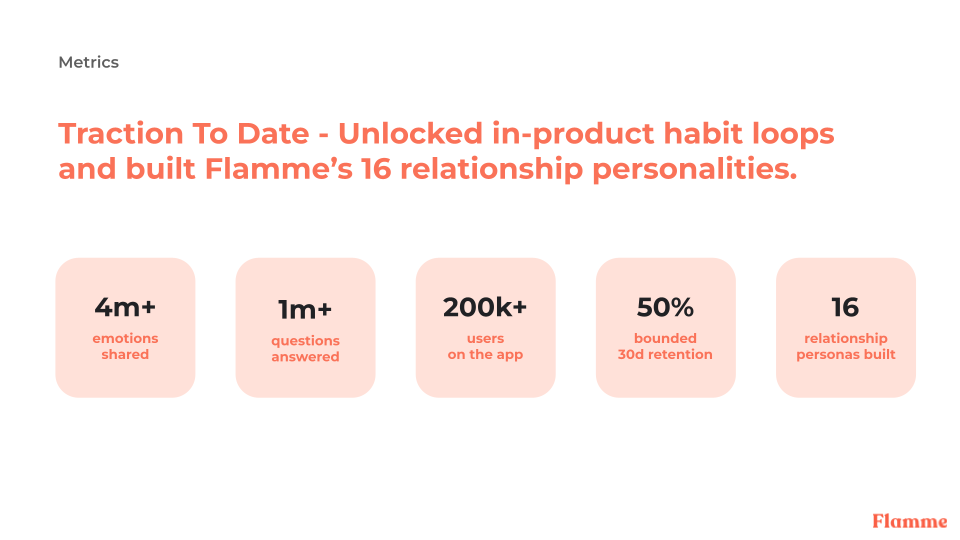
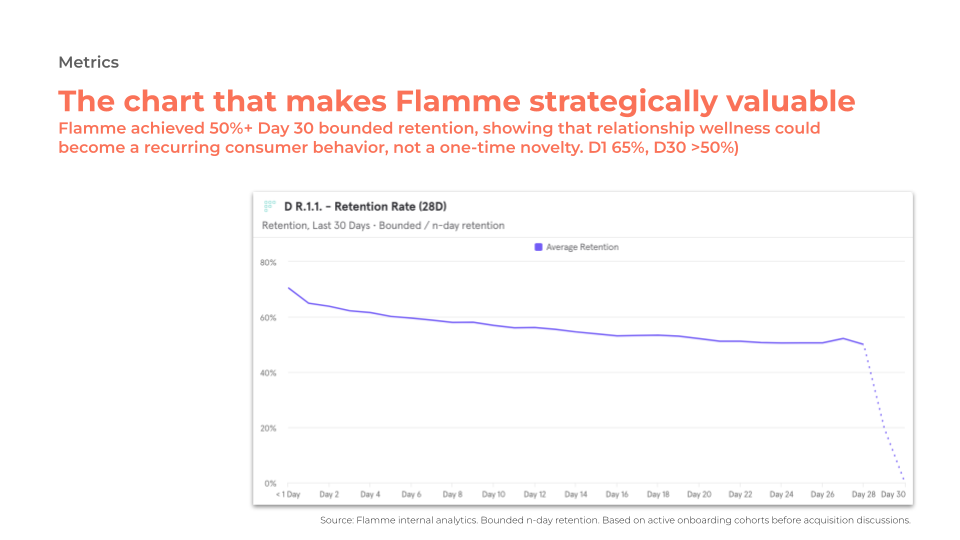
Arya didn't buy 50 million views. They bought a retention curve - Day 30 retention that climbed from 0.8% to over 50%. That's the number that actually got priced into the deal.
The Two Numbers Aren't the Same Thing
Views and retention measure two completely different things, and it's worth being precise about the difference.
Views prove people noticed you. Retention proves people needed you. One is attention and the other is whether the product delivered on whatever made someone open it in the first place. You can have an enormous amount of the first and almost none of the second - plenty of viral apps have proven that the hard way.
What It Actually Took to Move From 0.8% to 50%
This wasn't a hack, and it wasn't a single insight. It took 12 to 18 months, and it wasn't a smooth line - it was a series of pivots, each one testing what people actually valued, then doubling down on the part that worked.
The first real pivot came from admitting something uncomfortable: people did not want to open the app every day just to talk to an AI coach. This was 2023 - AI coaching felt novel, but novelty isn't a daily habit. There wasn't enough pull in "talk to your AI" alone to justify a Day 30 open.
The behavior that did have pull was simpler: a daily question, and the interaction loop between partners built around it.
Once that one behavior was identified as the actual reason people came back, the work shifted from "build more AI features" to "deepen this one loop as much as possible."
That deepening used fairly classic behavior-design thinking - the same principles behind most habit-forming products: push notifications tied to the daily question, triggers when your partner updated something, FOMO-style mechanics around missing today's prompt, and repeated reinforcement around that single core behavior. None of it was novel individually. What mattered was that it was all pointed at one identified behavior instead of spread across a dozen features hoping one would stick.
The broader lesson: retention didn't come from inspiration. It came from finding one high-return behavior and refusing to dilute focus away from it - iterate, launch, observe, test, double down, repeat.
Why This Is the Number an Acquirer Actually Prices
Views are a marketing input. Retention is a business asset. An acquirer isn't buying the fact that people noticed you once - they're buying evidence that people keep coming back without you having to re-earn their attention every day.
Views got us noticed. Retention got us bought.
Here's the simplest way to picture the relationship: think of growth as a bucket. Marketing fills the top. Distribution, virality, organic reach - all of it pours users in. But if the bottom of the bucket is wide open, none of that inflow compounds into anything. Retention is what narrows the hole. Without it, the top of the bucket doesn't matter how fast you're filling it.
The Real Trap Isn't Distribution - It's Stopping There
This isn't an argument against virality, and I'd be lying to my own track record if I made it one. Distribution matters. The mistake isn't building distribution - it's treating distribution as the finish line instead of the top of the funnel for a retention problem.
The actual system that creates value has three parts, not one:
- Distribution brings attention.
- Conversion turns attention into revenue.
- Retention keeps users around and reduces churn.
Chase virality as the goal itself, and you'll get a lot of people noticing you once. Chase the reason someone opens the app on day 30, and you build something an acquirer eventually wants to buy.
A Short Audit
Before you celebrate your next spike in views, ask:
- What % of my growth conversations this month were about views versus retention?
- Do I know, specifically, why someone opens the app on day 7? Day 14? Day 30?
- Have I identified the one behavior people actually come back for, or am I spreading effort across features hoping one sticks?
- If the marketing stopped tomorrow, would the users I already have keep coming back?
If you can't answer the third one, that's usually the real work waiting to be done - not the next post, not the next campaign.
Closing the Loop
50 million views got Flamme noticed. A retention curve that took 18 months of unglamorous, compounding work is what made it worth buying. If you only remember one thing from this: fill the bucket if you want, but the number that actually matters is how much of it stays in.