the barrier to building is gone, but the barrier to distribution is still standing high.
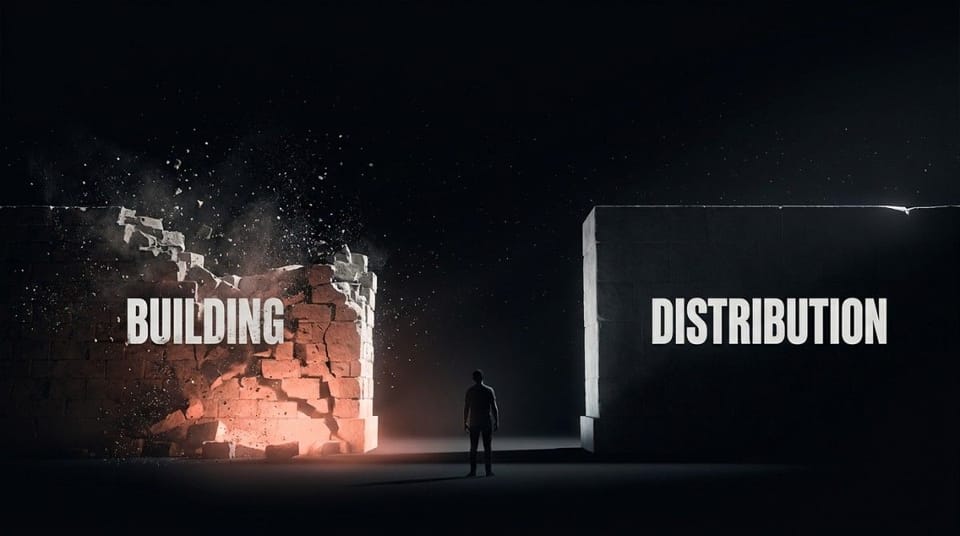
I build consumer apps for a living. A lot of the people I talk to do too. And over the last year I watched something happen that I didn't fully have words for until recently: the hardest part of the job disappeared, and almost nobody noticed the part that was left standing.
Shipping the app stopped being the hard part.
That sounds like a flex. It isn't, it's just true now. Claude, Codex, Rork, Anything… any AI will write you a real, polished product in a weekend. Real architecture, real screens, real ship-ready builds. I've watched people put out four apps with five more in progress, and land on zero users and zero revenue. The making got solved. We all felt it happen.
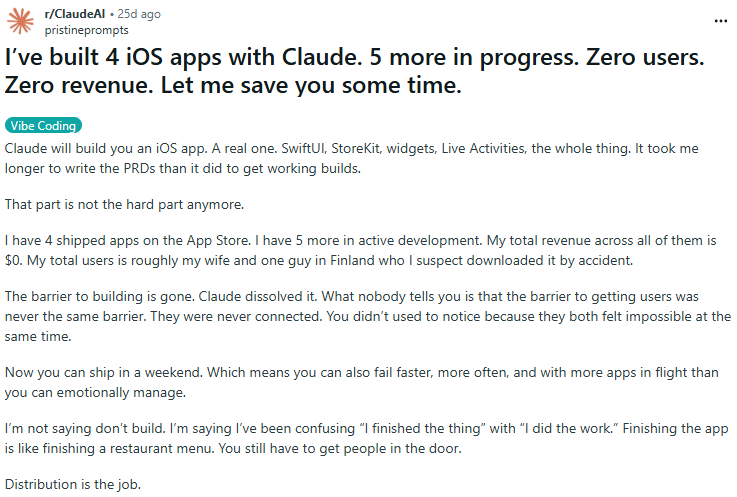
What nobody connected is the other half of that sentence. The barrier to getting users was never the same barrier as the barrier to building. They just happened to feel impossible at the same time, so for years we filed them under one word and called it "hard." Now one of those walls is gone, and the other one is standing right where it always was, fully intact, staring at you.
That wall has a name. DISTRIBUTION.
the two walls were never the same wall
Here is the trap. For most of the last decade, building and distribution failed together, so we assumed they were one problem. You couldn't ship, and you couldn't get seen, so you blamed a vague feeling of difficulty and kept grinding.
When AI knocked out the building wall, it exposed something we should have seen all along: getting attention was always its own separate, unsolved problem. It didn't get easier just because code got easier. If anything it got harder, because now everyone can ship, the feed is more crowded, and the only thing standing between a good product and oblivion is whether anyone ever sees it.
So we have this strange moment where the part that used to take a team of engineers takes an afternoon, and the part everyone assumed would sort itself out is the thing killing good products. It isn’t bad code or bad design. It is invisibility.
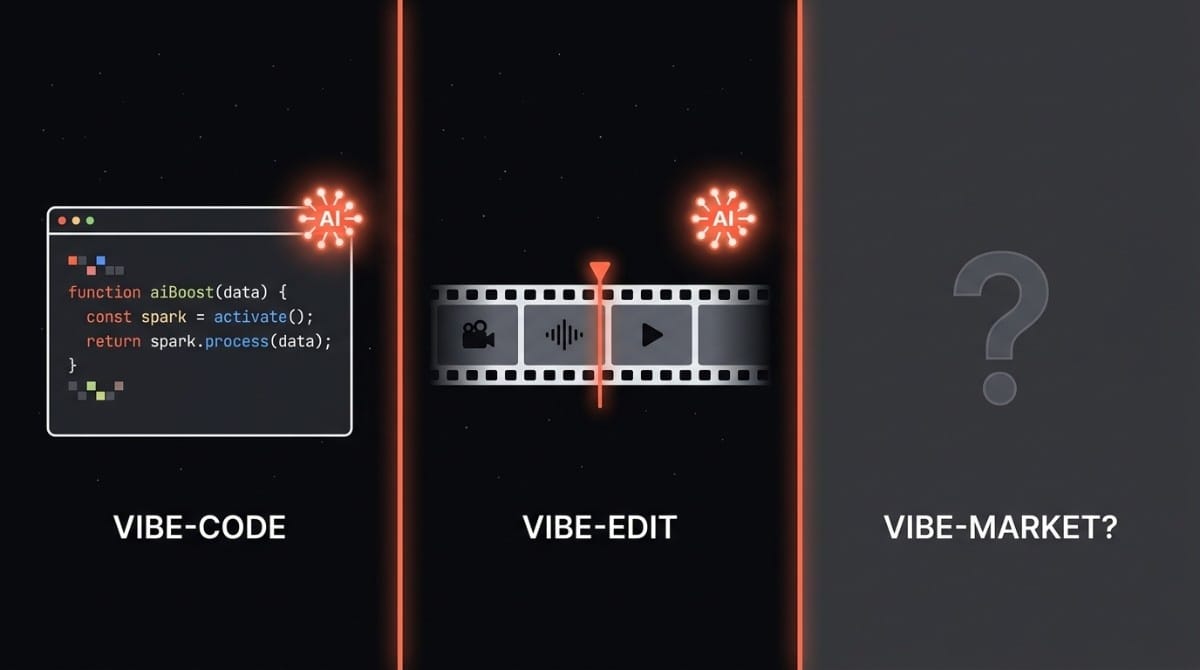
we vibe-code. We vibe-edit. Nobody vibe-markets.
Look at where AI has actually taken over, and a pattern jumps out.
We vibe-code the app. We vibe-edit the footage, a whole cut in one pass. The making side of building a company got an unfair, almost absurd advantage. You can feel it everywhere.
The growth side? Still you. At 1am. Scrolling TikTok with a thumb on autopilot. Saving 40 videos you'll never use. Guessing which format might pop. Shooting in the dark and calling it a content strategy.
I did exactly this for months, and I want to be specific about why it was so painful, because "make more content" hides three very real costs:
- It eats your week. Four-plus hours a day scrolling and "researching," saving things, telling yourself it counts as work.
- It's a blind bet. You genuinely cannot tell what will convert views into installs until you've already shot it, posted it, and watched it die. The feedback comes too late to change anything.
- It doesn't even get cheaper if you outsource. UGC at any real scale runs $25 to $200 a video, which is a lot of money to spend finding out you guessed wrong.
The build got an AI co-pilot. The distribution didn't. That is the gap. And it is the single thing I'd point to if you asked me why so many genuinely good indie apps never make it past their own launch day.
So I built the thing I needed.
meet "Handler".
Built with enough experience scaling products on TikTok to know what actually works.
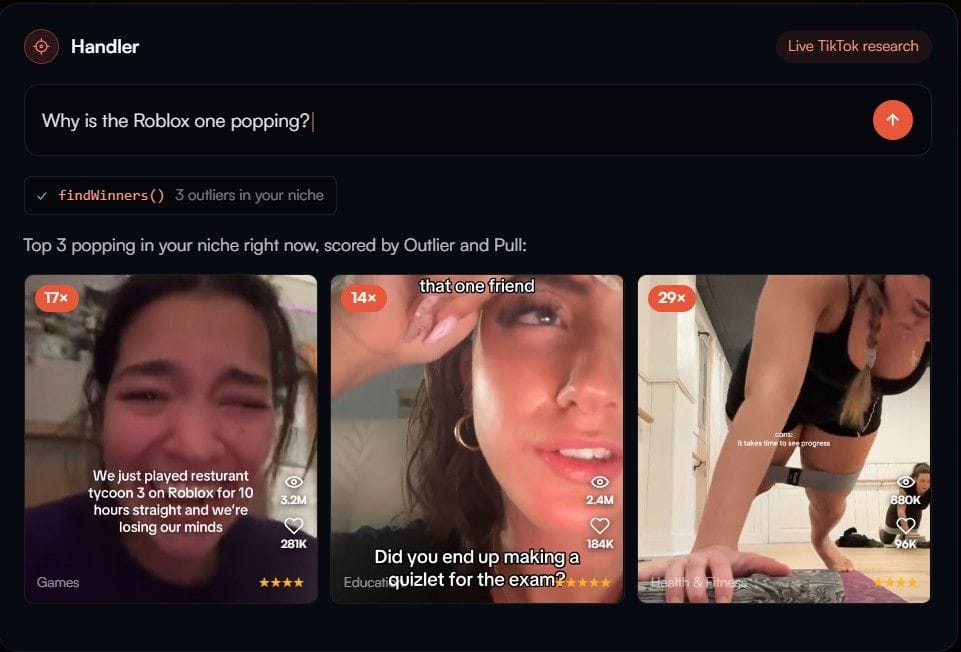
You just talk with Handler, your vibe marketing agent. It's the top layer of the whole product, an AI agent that works like a growth operator sitting on top of real TikTok research. No dashboards, no filters, no fifteen open tabs. You just ask, the way you'd ask a teammate who already did the homework:
- "Find me 3 winners in my niche."
- "Why does this one pop?"
- "Give me 3 videos I could shoot this week."
- "Hand me the kit for #2."
Handler routes each request to a real tool and renders the answer right back to you: actual posts, real analysis, a ready-to-shoot kit. It proposes, you approve. That's the whole interaction.
And the homework underneath it is real. The engine is TikSpy. You give it your niche, and it surfaces the TikToks already winning in your exact industry, then scores every one on the two things that actually matter:
- Outlier Score is how far a video beat its own account's baseline. A 200K-view post from a 10K account is a much bigger signal than a 1M-view post from a 2M account. The second one is just gravity. The first one is a format that breaks out regardless of who posts it, which is the only kind of signal that transfers to you. It measures that, not vanity views.
- Pull Score is how hard the post actually moved people. Views are passive. Comments are intent. So we read the comments, and you find out whether a video created real demand or just collected attention, before you copy it instead of after.
Then Handler hands you the part that matters: a plain-English brief on why it worked, the comment read on what that audience is actually asking for, and a full dupe kit, the regeneration prompt, the brand overlay, the sound recommendation, and the adaptation notes to rebuild the structure for your own app.
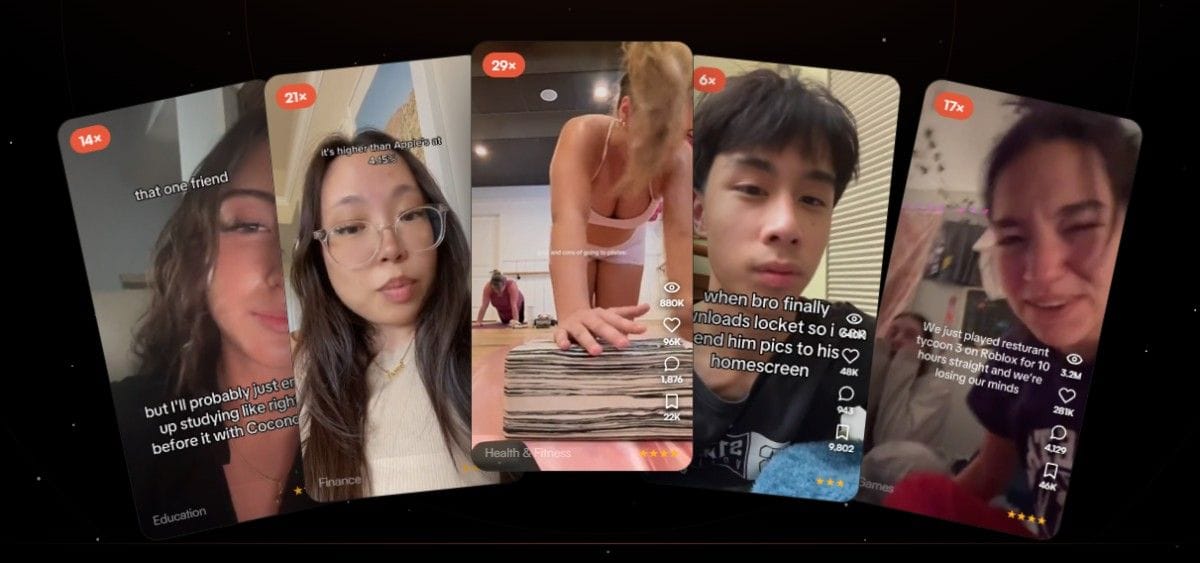
Not blind copying. Pattern adaptation. You take what's already proven in your niche and make it yours.
That's the loop that's live today: find the winner, understand it, get the kit. It already runs across the niches we've opened, EdTech, Fitness, Finance, Health, Games, Lifestyle. The rest of the content engine is coming next, DupeFarm to rebuild those winners with your own AI creators, and ReDupe to re-spin and scale the ones that hit.
this is vibe marketing. this is vibe influencing.
That's the framing I keep coming back to, because it's the honest one. Vibe coding gave the builder an operator for the build. Vibe editing gave them an operator for the cut. Handler is the operator for the part in between that everyone forgot about: deciding what to actually say to the market, and saying it, over and over, until you're impossible to miss.
You ask what's working, why it works, what to shoot this week, and how to recreate it. Handler turns it into something you can actually post. The blank page is gone. The trend hunting is gone. The weekly "what should we post today" stare-down is gone. What's left is the only part that still needs a human: the calls a tool can't make.
TikSpy finds the outliers. Handler turns them into action.
go solve the other half
I don't think the lesson of this era is that building doesn't matter. Build a thing worth seeing. That part is real.
The lesson is that "worth seeing" and "seen" are two different achievements now, and only one of them got automated. If you've shipped something good and you're staring at a dead install graph, the problem almost certainly isn't your product. It's the wall nobody warned you was still there.
I built the Handler so I'd never have to scroll for four hours guessing again. If that's the wall you're stuck behind too, it's free to start, and your first scan is on us:
We are launching this Thursday, 2nd of July, 2026. Mark your calendar.
The barrier to building is gone. Let's go kill the one that's left.
If you want the longer version of how I actually ran this loop, the farm, the volume, the things that broke at scale, I broke it all down in a separate piece: how we got to 50M+ organic views with a team of one →.
– An